It’s not uncommon to run across a Federal Pacific Stab-Lok panel during a home inspection… and like it or not, it is a bit of a red flag. Buyers need to understand why they matter before closing day.
Why Federal Pacific Stab-Lok Panels Get So Much Attention
If you are buying a home built between the 1950s and the 1980s, there is a chance it may contain a Federal Pacific Stab-Lok electrical panel. As inspectors, we do not call them out for fun or to be “deal killers”. We call them out because of documented safety concerns tied to how their breakers perform.
Electrical panels are designed to shut off power when circuits overload or when there is a short. That shutdown prevents overheating, fire, and damage to appliances. The concern with Stab-Lok breakers is that some of them have been shown to fail to trip under certain conditions. That is not a cosmetic issue. That is a safety issue.
For buyers, this becomes a negotiation point. For agents, it becomes a transaction management issue. For inspectors, it is a documentation and education moment.
“I’ve Never Had Any Problems” Is Not Proof
This comes up a lot, especially from sellers. “We’ve lived here for years and never had an issue.” As someone who lives in an older home, I get it. It sounds reasonable. It is also backward-looking logic.
A breaker’s whole job is to work the one time you actually need it. You can go for decades without ever putting a circuit under the kind of overload that truly tests a breaker. That does not prove it works. It only proves it has not been pushed hard enough yet.
No house was ever on fire.. until it was.
This is not about inciting panic or creating unnecessary alarm… it is about risk management. The goal is to keep it “no problems” going forward.
A Brief History of Federal Pacific Stab-Lok Panels
Federal Pacific Electric, often abbreviated as FPE, manufactured Stab-Lok panels for decades. In the late 1970s and early 1980s, concerns surfaced about testing irregularities and breaker performance.
The Consumer Product Safety Commission investigated the panels but ultimately did not issue a full recall. The lack of a formal recall sometimes confuses buyers. No recall does not automatically mean no risk. It simply means the regulatory path did not result in mandatory replacement.
Some people will use “no recall” as a reason to shrug this off. Here’s the balanced version:
It’s true there was no full recall. It’s also true that independent testing and long-standing industry concern have raised serious questions about breaker trip performance. Buyers are allowed to factor that into their decision.
You can review background information directly from the CPSC website here: https://www.cpsc.gov
How to Identify Federal Pacific Stab-Lok Panels
Buyers often ask, “How do I know if the home has one?”
Here are common identifiers:
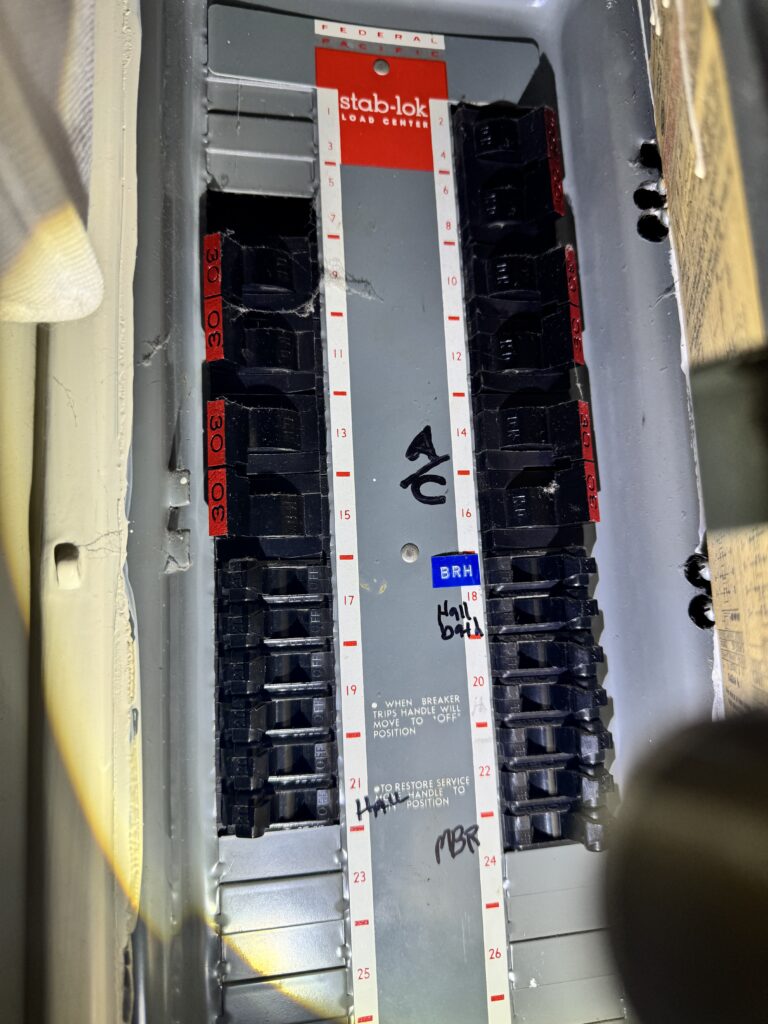
- The panel label says Federal Pacific Electric or FPE
- Breakers have red stripes or red-tipped handles
- The word Stab-Lok appears on the panel label
Visual Example of a Stab-Lok Panel
During an inspection, we remove the panel cover when safe to do so and document the brand and configuration. If we see Federal Pacific Stab-Lok panels, they are clearly noted in the report with photos.
Overload vs. Short Circuit: What’s the Concern?
The issue centers on breaker trip failure. A properly functioning breaker should trip when a circuit is overloaded or when a short circuit occurs… and this is worth being specific about.
Overload conditions are the most commonly cited concern. That is when a circuit is pulling more current than it is rated for over time. Think space heater, hair dryer, microwave, all stacking up on the same circuit. A breaker should trip before wiring overheats.
Short circuit conditions are more sudden. That is when hot contacts neutral or ground directly. Current spikes fast and a breaker should trip almost immediately.
With Stab-Lok, the concern is primarily failure to trip during overload conditions, with additional concerns reported under short circuit conditions in some testing.
Why Breaker Failure Matters
Electrical systems rely on layered protection. The breaker is one of the primary safety devices in that chain. If it fails, the system loses its built-in defense.
From a buyer’s perspective, this becomes a risk tolerance question. From an agent’s perspective, it becomes a disclosure and negotiation discussion.
Are All Federal Pacific Stab-Lok Panels Dangerous?
Not every Federal Pacific Stab-Lok panel has failed. Not every breaker will malfunction. Many homes with these panels have not experienced electrical fires. But home inspections are about risk assessment, not waiting for failure. Because of the documented concerns and the age of these systems, most inspectors recommend replacement rather than repair. Replacement eliminates uncertainty and modernizes the electrical service.
This is also where some pushback shows up. You will hear things like, “If there is nothing wrong with it, why replace it?”
Here is the simple answer.
We do not expect everything in an older home to be perfect and new. We do expect safety components to function as intended for the purpose they were intended. If a breaker has a known history of not doing the one thing it exists to do, that matters.
Replacement vs. Repair: What Buyers Should Expect
When Federal Pacific Stab-Lok panels are identified, buyers typically have three options:
- Request seller replacement before closing
- Negotiate a credit
- Accept the risk and plan for future replacement
Typical Replacement Costs
Costs vary by region and service size, but panel replacement often ranges from $1,500 to $3,500 or more. If service upgrades or grounding corrections are needed, costs can increase.
Agents should prepare buyers for this range early. Surprises late in escrow are rarely fun to talk about.
Insurance and Federal Pacific Stab-Lok Panels
Some insurance carriers are hesitant to insure homes with Federal Pacific Stab-Lok panels. Others may require replacement before issuing a policy. This can directly impact a buyer’s ability to close.
I am not saying insurance companies are the safety authority. I am saying they are not emotional. They are statistical. If carriers are flagging these panels, it is a signal that risk is being priced and managed on their side too.
If your client is purchasing a home with this panel type, encourage them to contact their insurance provider early. Waiting until the week before closing can create unnecessary stress.
What Inspectors Actually Report
When we encounter Federal Pacific Stab-Lok panels, we typically document:
- Brand and model
- Visible condition of breakers
- Signs of overheating or corrosion
- Any improper wiring or double taps
We also recommend evaluation by a licensed electrician and typically recommend replacement due to known safety concerns. We do not declare the home unsafe. We provide facts, context, and professional recommendations. That distinction keeps the conversation grounded instead of turning it into a scare-fest.
Why Agents Need to Understand This Issue
Agents often carry the emotional load in these conversations. Buyers see the words Federal Pacific Stab-Lok panels in a report and head straight to the internet. The internet is not known for moderation.
By understanding the issue, agents can:
- Set expectations early
- Frame the discussion as risk management
- Guide buyers toward informed decisions
- Avoid last-minute panic
This is not about killing deals. It is about protecting clients and reducing liability.
Can You Just Replace the Breakers?
Some companies manufacture replacement Stab-Lok breakers. However, this approach does not address concerns about the panel bus design or the original connection system. Most electricians recommend full panel replacement rather than swapping breakers in an aging Federal Pacific panel. If the panel is already several decades old, replacement often makes more financial sense long term.
What Buyers Should Do If a Home Has a Stab-Lok Panel
If your inspection report identifies Federal Pacific Stab-Lok panels:
- Get a licensed electrician’s opinion
- Obtain a written estimate
- Check with your insurance provider
- Discuss negotiation strategy with your agent
Do not ignore it. Do not panic. Gather facts and make a decision that aligns with your risk tolerance and budget.
Modern Electrical Panels Offer Better Protection
Today’s panels include improved breaker designs, better grounding standards, and compatibility with arc fault and ground fault protection. Upgrading from Federal Pacific Stab-Lok panels is not just about eliminating a concern. It is also about modernizing the home’s electrical safety.
The Bottom Line on Federal Pacific Stab-Lok Panels
Federal Pacific Stab-Lok panels represent a known electrical concern tied to breaker performance. While not every panel has failed, the documented history and testing results make them a common recommendation for replacement. For buyers, this is a budgeting and safety decision. For agents, it is a transaction strategy conversation. For inspectors, it is a duty to inform.
No drama. Just facts and informed choices.
If you are buying an older home and have questions about its electrical system, schedule a professional inspection and get clarity before you close. It is far easier to negotiate before the keys change hands.